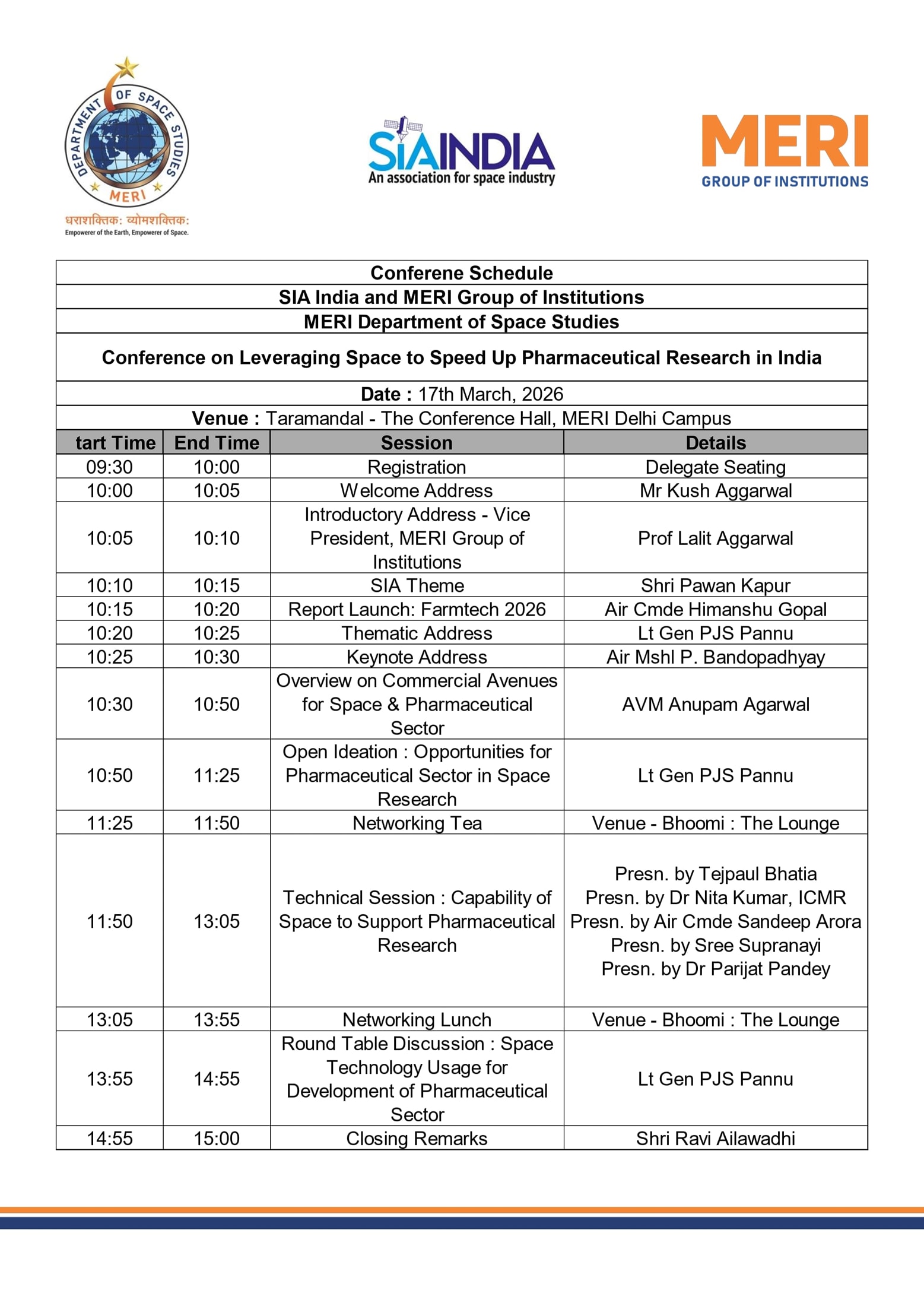
Conference on Leveraging Space to Speed Up Pharmaceutical Research in India
Date: 17th March, 2026 Venue: Taramandal – The Conference Hall, MERI Delhi Campus Organized by: MERI Department of Space Studies and Space Industries Association of India (SIA-India)
About the Conference
The Pharmatech Conference is a national level initiative focused on integrating space technology with pharmaceutical research and healthcare applications. With advancements driven by the Indian Space Research Organisation and global missions aboard the International Space Station, space research today plays a growing role in medical and biotech innovation.
The healthcare sector faces challenges in drug development, research efficiency, commercialization, and coordinated policy frameworks. Microgravity based experiments, protein crystallization, cancer studies, and tissue culture research offer new pathways for scientific advancement and scalable healthcare solutions.
This conference serves as a strategic platform for industry leaders, policymakers, researchers, and healthcare professionals to discuss collaboration models, develop a shared vision, and propose actionable strategies for converting space-based research into sustainable, market-driven healthcare growth.
Where
Taramandal – The Conference Hall, MERI Delhi Campus
When
17th March, 2026
Register Now
Event Schedule
Our Speakers
Prof Lalit Aggarwal
Vice President, MERI Group of Institutions
Air Mshl P. Bandopadhyay
PVSM, Padma Shri, AVSM, VSM, PHS
Shri Anil Prakash
Director General, SIA-India
Lt Gen (Dr) PJS Pannu (Retd.)
Professor & Chief Mentor, MERI Department of Space Studies
Shri Ravi Ailawadhi
Regional Director, South Asia, Methera Global Communications Limited
AVM Anupam Agarwal
VSM
Dr Neeta Kumar
ICMR
Air Cmde Sandeep Arora
Senior Consultant Dermatologist
Tejpaul Bhatia
Dr Parijat Pandey
Assistant Professor, Gurugram University
Sree Supranayi
Co-Founder, AnduraX Pvt Ltd
Air Cmde Himanshu Gopal
Who Should Attend
Medical Universities & Research Institutions
Central & State Government Officials
Space Sector Experts (ISRO & Startups)
Pharmaceutical & Biotech Companies
Healthcare Innovators & Entrepreneurs
Scope of the Conference
Pharmatech 2026 will comprehensively explore how space and allied technologies can accelerate pharmaceutical research and strengthen healthcare systems through the following focus areas:
Entrepreneurial and Industry Collaboration Opportunities
The event will also examine the role of private space companies, biotech firms, and research institutions in building a sustainable space-based pharmaceutical ecosystem through strategic partnerships and innovation platforms.
Appropriateness of Drugs in Space Analog Settings
Deliberations will examine how medicines perform in space-like conditions such as isolation, radiation exposure, and microgravity simulations.
Extending Expiry and Drug Stability in Space Conditions
The Conference will analyze how radiation, temperature fluctuations, and prolonged storage impact drug stability.
Advanced Pharmaceutical Packaging for Space
The conference will explore innovative radiation-shielding and environment-resistant packaging solutions designed to maintain medicine stability during launch, storage, and extended missions.
3D Printing and Single-Dose Drug Innovations
Discussions will highlight the potential of 3D-printed medicines and single-dose combination tablets to reduce pill burden, optimize storage, and enable customized treatment for astronauts.
Objectives of the Conference
Strengthen Space–Pharma Integration
To develop a strategic vision for integrating space research with pharmaceutical and healthcare sectors, supporting innovation, astronaut health, and long-term mission safety.
Evaluate Drug Safety in Space Conditions
To assess the appropriateness, stability, dosage, and effectiveness of medicines in space analog environments and microgravity simulations.
Advance Drug Stability and Packaging Solutions
To explore methods for extending drug shelf life and developing radiation-resistant, environment-protective pharmaceutical packaging for long-duration missions.
Promote Innovative Drug Delivery Systems
To examine emerging solutions such as 3D-printed medicines and single-dose combination tablets that reduce pill burden and enable customized treatment in space.
Foster Cross-Sector Collaboration
To build structured collaboration among space agencies, pharmaceutical companies, biotechnology firms, academic institutions, and government bodies for a sustainable space-enabled healthcare ecosystem.
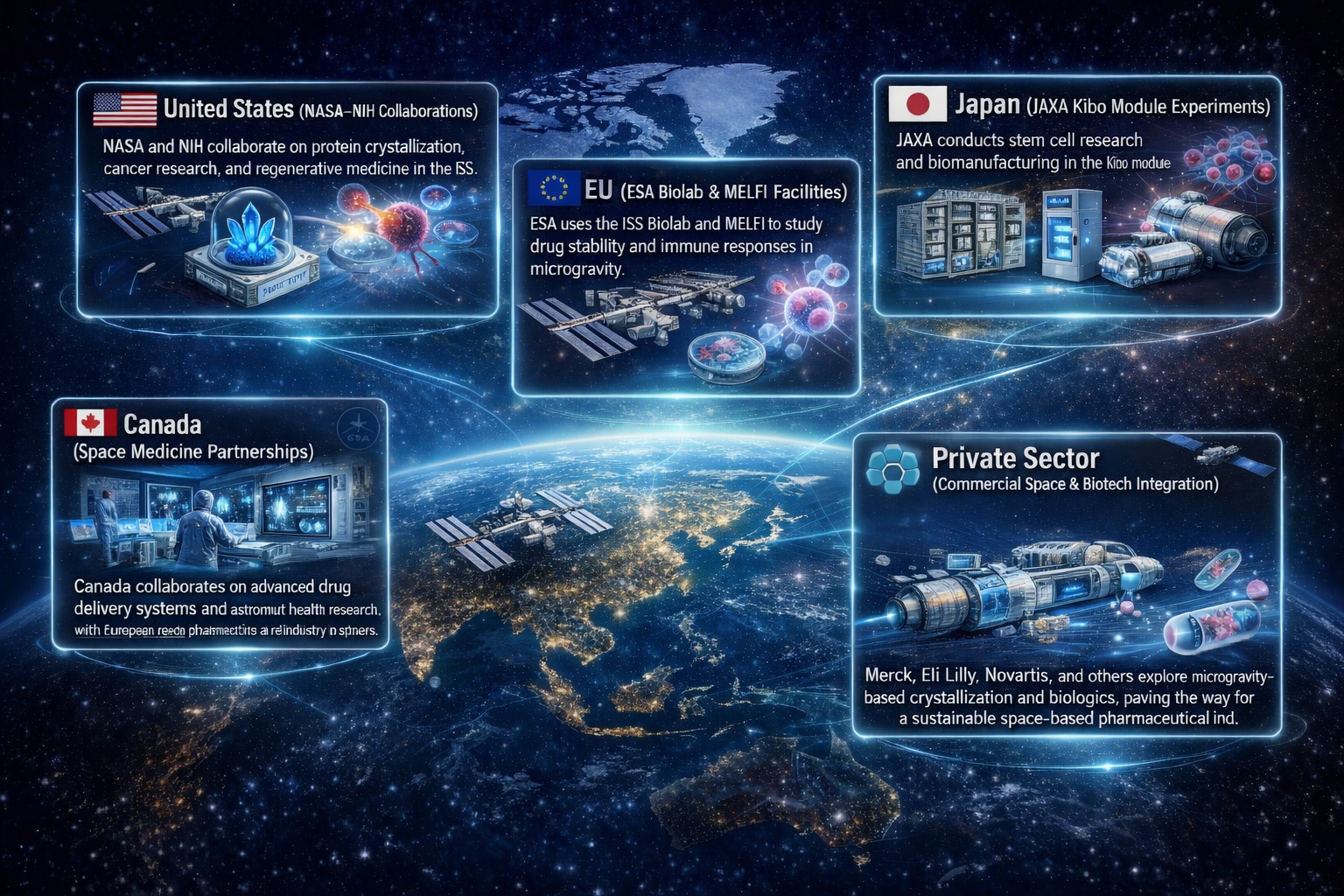
Adoption of Space Technologies in Pharmaceutical Research by Developed Nations
Several developed nations have actively integrated space technologies into pharmaceutical research, creating scalable models that combine scientific advancement with commercial application. These examples offer strategic insights for India’s expanding space healthcare ecosystem.
United States (NASA–NIH Collaborations)
The United States leverages collaborations between NASA and the National Institutes of Health to advance protein crystallization, cancer research, and regenerative medicine in microgravity. International Space Station experiments help researchers better understand drug behavior, toxicity, and cellular responses.
European Union (ESA Biolab & MELFI Facilities)
Through the European Space Agency, Europe utilizes ISS facilities such as Biolab and MELFI to study drug stability and immune responses in microgravity. These programs connect research institutions and industry partners for coordinated pharmaceutical testing and advanced biomedical experimentation in space environments.
Japan (JAXA Kibo Module Experiments)
Japan Aerospace Exploration Agency (JAXA) conducts stem cell research and biomanufacturing experiments through its Kibo module on the ISS. Microgravity-based studies have supported advancements in tissue engineering and biologics, strengthening Japan’s position in space-enabled medical innovation.
Canada (Space Medicine Partnerships)
Canada has developed focused partnerships in space medicine, emphasizing advanced drug delivery systems and astronaut health research. These collaborations demonstrate how coordination between healthcare institutions and space agencies can improve pharmaceutical reliability in extreme environments.
Private Sector (Commercial Space & Biotech Integration)
Global pharmaceutical companies such as Merck, Eli Lilly, and Novartis are exploring microgravity-based crystallization and biologics research through commercial low-Earth orbit platforms. Expanding private aerospace participation is reducing barriers to orbital experimentation and pharmaceutical innovation.
Venue
Taramandal – The Conference Hall, MERI Delhi Campus Organized by: MERI Department of Space Studies and Space Industries Association of India (SIA-India)